 Parks of Croatia
 EU projects
 English
JAPANESE BANTAM (CHABO)
Gallus gallus domesticus
CLASS AVES
ORDER GALLIFORMES
FAMILY PHASIANIDAE
DID YOU KNOW?
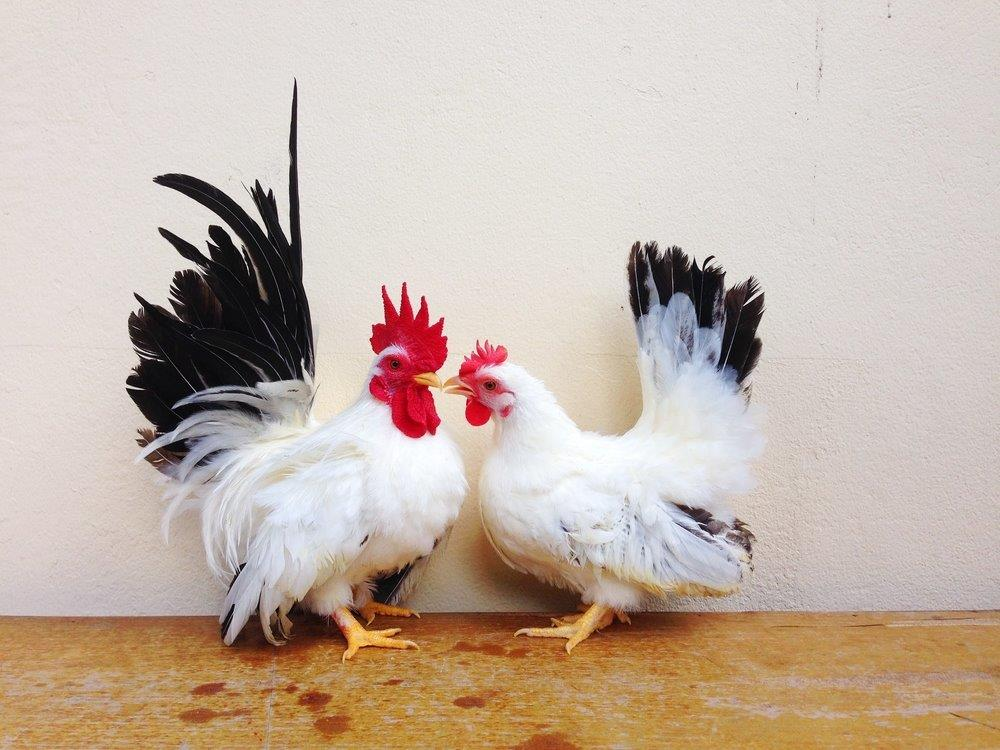
In Japan, another name for the Japanese bentham is shabo, which means dwarf; it was also an old Japanese name for Southeast Asia. The Japanese bantam is a "true bantam" meaning that the breed is originally small in stature, and not a dwarf replica of a normal sized breed.
DISTRIBUTION
The Japanese bantam cannot be found in the wild, because it is a domesticated breed. They survive all over the world if they are provided with shelter, food and a source of heat, because they are not resistant to cold conditions.
HABITAT
Enclosures adapted to the requirements of the species (spacious chicken coops).
LIFETIME
They live almost twice as long than ordinary chickens - females live from 13 to 16 years and males from 10 to 13 years. Males have a shorter lifespan due to their aggressive and territorial behavior.
ACTIVITY
This is a small type of chicken with very short legs whose tail rises above the head. It exists in several colors, and due to its uniqueness, it is mainly used as an exhibition species or as a pet. They can fly much better than ordinary chickens, and the males behave similar to other roosters, while the females are quite peaceful. In order to maintain optimal health, they need twice as much space than regular chickens. Females lay only about 75 eggs per year. They are one of the breeds that carry a lethal gene (Cp) that causes the death of a certain percentage of embryos during incubation. The Japanese bantam lethal gene refers to short legs and dwarfism, which is the main characteristic of the species. You can read more about the way the lethal gene causes embryo mortality at the following link: https://www.np-brijuni.hr/hr/aktivnosti-parka/ruanska-patka-i-letalni-gen .
REPRODUCTION
They have similar rituals to other breeds of chickens – the male dances with his erect tail and lures the female before mating. Depending on the number of females in the enclosure, the male mates from 10 to 30 times a day. After 7 to 10 days, the female lays fertilized eggs, which are significantly smaller than the eggs of other hens. Then the incubation period takes place, the length of which depends on environmental conditions and the health of the female (20-30 days). Chicks come out of the shell by piercing with an egg tooth, which later falls off. Chicks can see immediately after birth, but it can take up to 24 hours for them to walk. After that, they stay with their mother for the first 2 months, after which they become independent.
DIET
Japanese bantams are omnivores – they eat plants, seeds, insects and worms. Occasionally, they may eat a small lizard or a mouse, but their primary diet consists of various grains.
CONSERVATION STATUS
They are not an endangered breed, although the population cannot significantly increase due to their reproductive biology (they lay very few eggs).
Text: Dorotea Ćosić
Contribution: Francisca Lopes