The richness of Brijuni is also amplified by geopaleontological sites where more than 200 dinosaur footprints of have been discovered. It is believed that these ancient reptiles walked Brijuni 130-100 million years ago.
Geological and paleontological sites
Promenade of dinosaurs
Dinosaur footprints within the Brijuni National Park area have been recorded on the island of Veliki Brijun as well as on the islands of Vanga, Galija, and Vrsar. To date, a total of nine sites are known, where four different types of footprints have been identified, indicating that four types of dinosaurs once walked along the Brijuni shores during the Cretaceous period: large and small carnivorous theropods, and two herbivorous forms – ornithopods and sauropods. This is an exceptionally large number considering the very small land area of Brijuni National Park (only 7.43 km²) and the limited conditions for the preservation of fossil traces.
Visitors to the National Park can access sites on Veliki Brijun, specifically at the Ploče and Vrbanj (Barban/Pogledalo) capes. Two locations, Kamik Cape and Trstike Cape on the Peneda Peninsula, are not accessible as they are located in an area managed by the Croatian Ministry of Defence. The sites on the outer islands of Vanga, Galija, and Vrsar are also not open to visitors.
First encounter with a dinosaur footprint
Dinosaurs (Greek deinos – terrible + sauros – lizard, reptile) greet us already when disembarking from the boat, at the pier of the Brijuni harbor! In a limestone block brought from one of the Brijuni quarries, a clearly visible three-toed dinosaur footprint can be seen. It appears to have belonged to a large carnivore from the Theropoda group. The track was discovered in 1999 and marked in 2008 with an informational plaque.
200 dinosaur footprints
Brijuni Cretaceous park
To date, a total of 294 fossil dinosaur footprints have been recorded in the Brijuni National Park area. The most numerous are tracks of small carnivorous theropods (167), followed by large theropods (60), long-necked sauropods (40), and ornithopods (27). It is interesting that tracks of small theropods are the most common, even though these dinosaurs were significantly lighter (on average around 100 kg), which reduces the likelihood of their footprints being preserved. In comparison, ornithopods could weigh over 3 tons, while sauropods often exceeded 10 tons in mass.
The geologically oldest site is located at Cape Vrbanj (Barban/Pogledalo), where limestones with footprints are dated to the Early Cretaceous period, between 130 and 125 million years ago. The remaining eight sites also belong to the Early Cretaceous but are slightly younger, around 105 million years old, which is also the age of most dinosaur fossil tracks in Croatia. This implies that dinosaurs inhabited the area of present-day Brijuni continuously or intermittently for about 20 million years. In comparison, modern humans (Homo sapiens) have existed on Earth for only about 300,000 years.
Dinosaur research on Brijuni
Fossil dinosaur footprints and their trackways on Veliki Brijun have been known since the early 20th century. Locals referred to them as “devil’s tracks” or “devil’s footprints” (“le zette del diavolo”). Robert Čufar (Zuffar), son of the well-known Brijuni forester Alojzije Čufar, already recognized their significance in 1907 and mentioned them in his 1917 memoirs as traces of “some saurus from the Triassic period.”
The first scientific description of the dinosaur tracks was provided by Austrian paleontologist Baron Adolf Bachofen von Echt in 1925, making them the first scientifically described dinosaur fossils in Croatia, and also the first south of the Alps. In his works from 1925 and 1926, he described tracks from Cape Ploče, attributing them to the herbivorous dinosaur Iguanodon. Today we know that these footprints actually belonged to small carnivorous theropods. Bachofen von Echt also first described tracks attributed to turtles, which are still debated today as to whether they are of natural or anthropogenic origin, possibly resulting from stone quarrying.
The period from 1947 to 1980, when Brijuni served as the residence of Josip Broz Tito, was marked by restricted access to the islands and reduced research activity. During the production of the Basic Geological Map of the SFRY in 1965, Brijuni sites were mentioned again, including the Vrbanj/Barban site, as well as a third site, Kamik/Plješivac, which was described in more detail in a 1987 study.
A real surge in research began in the 1990s, when Croatian and Italian scientists started systematic paleontological investigations. New sites were discovered and documented, including those on the islands of Vanga, Galija, and Vrsar, and reconstructions of dinosaur size and appearance were made based on their footprints.
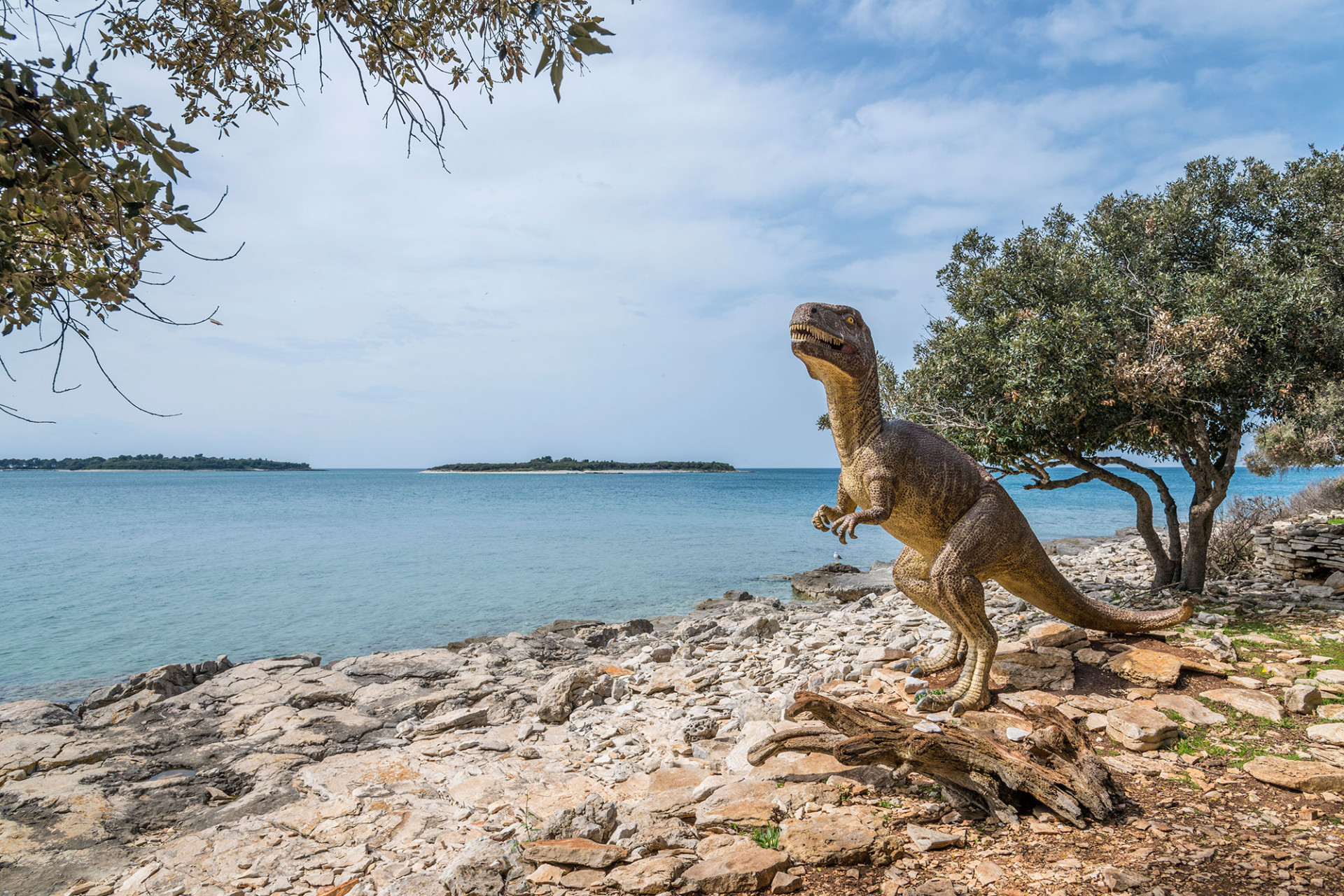
In 2008, a theropod footprint was marked in a rock block in the Brijuni harbor, brought from one of the former quarries on Veliki Brijun. At the Vrbanj (Barban/Pogledalo) site, a life-sized theropod dinosaur sculpture was installed in 2012, based on measurements of footprints and trackways from that locality. The most recent research from 2023 to 2025 provides the first more detailed descriptions of tracks from the Vanga and Galija sites, and also includes studies of the Vrsar site. Research is ongoing, and new discoveries are still possible.
Although the first traces of dinosaurs on Brijuni were discovered already in 1925, more detailed research has been conducted only recently. In the 1990s, paleoichnological research was conducted to study the manner in which fossilized animals moved. Thus, from a footprint, and in particular a series of footprints – trails, a whole range of data was obtained: the size of the animal, whether they were bipedal or quadrupedal, whether they ran or walked slowly, alone or in herd.
Right after leaving the boat, dinosaurs are waiting for us at the jetty of the Brijuni port! In the limestone block brought from one of the Brijuni quarries, you can clearly see a three-toed footprint of a dinosaur. As it seems, it belonged to a large carnivore from the group of Theropods.
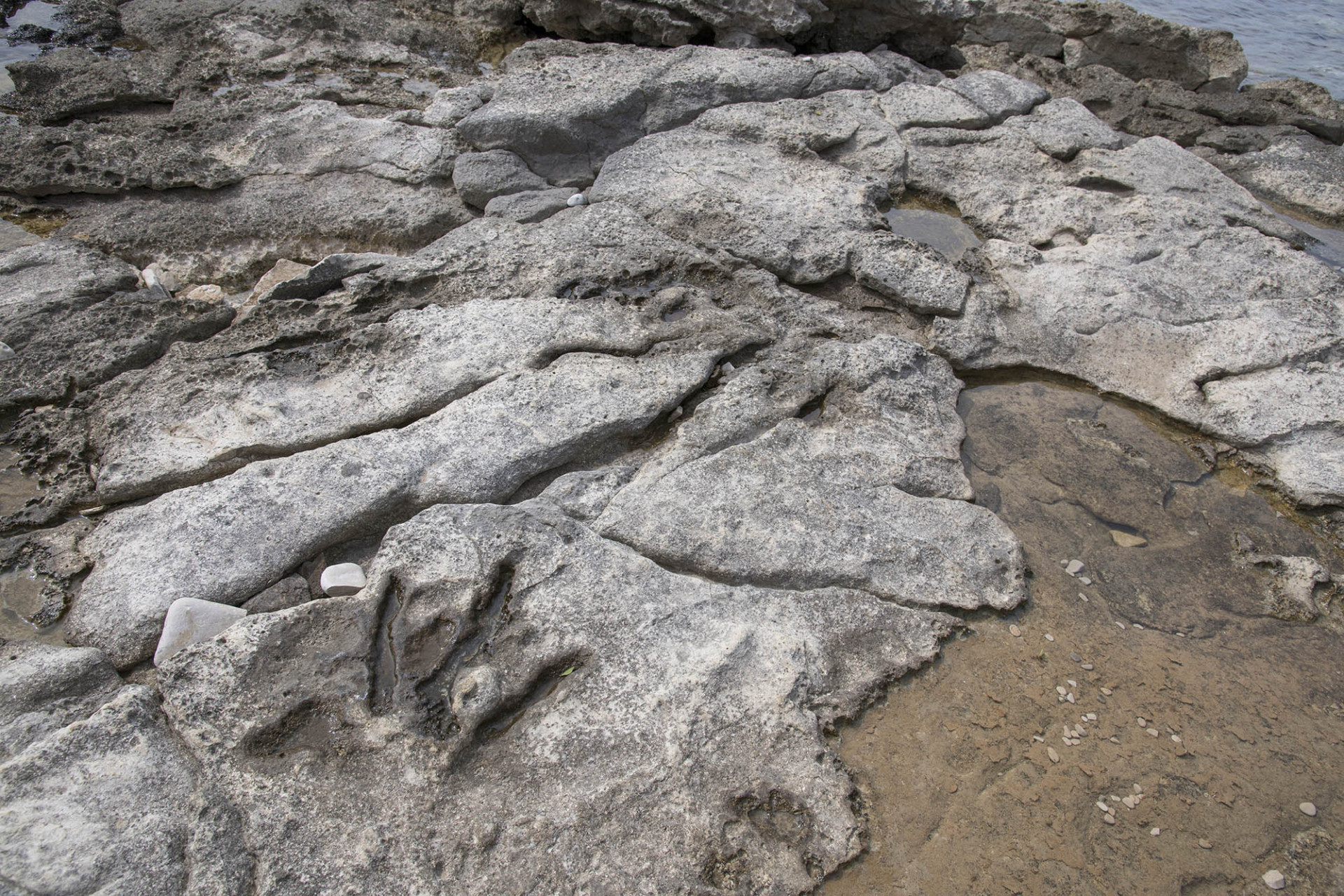
At Vrbanj/Pogledalo/Barban Cape, around sixty footprints of large bipedal carnivorous dinosaurs have been discovered.
The three-toed shape of the footprints indicates that they belonged to theropods—predatory carnivores that left their tracks while walking through the shallow waters of the ancient Tethys Ocean. Of the roughly sixty fossil footprints, 15 form four trackways (at least three consecutive tracks). The trackways are between 7.5 and 8 meters long, and the animals moved at a light walking speed of around 5 km/h.
Based on the shape and size of the footprints, trackway parameters, similar theropod finds worldwide, fossil bone records from the same period, paleogeography, and other data, it can be concluded that the tracks were made by theropod dinosaurs from the Carnosauria group (most likely allosaurids or carcharodontosaurids).
These footprints formed between 130 and 125 million years ago during the Early Cretaceous period and are the oldest geological finds among all Brijuni sites. They are currently the only fossil remains of large carnivorous theropod dinosaurs in Croatia. Furthermore, since fossil bone finds of Early Cretaceous carnosaurs are relatively rare in general, the Brijuni tracksite is of even greater scientific importance.
To help visitors visualize the size of these Mesozoic creatures, a life-sized reconstruction of a theropod dinosaur—a scientifically and artistically created sculpture of a predatory carnivore—was installed here in 2012 (https://www.np-brijuni.hr/en/b...).
Fossil trace of a large theropod dinosaur from Cape Vrbanj/Barban; photo by Irina Žeger Pleše.
Cape Ploče
At Ploče Cape on the Zelenikovac Peninsula lies the first scientifically described dinosaur fossil site in Croatia and beyond, where about fifty three-toed footprints of small bipedal carnivores from the Theropoda group were discovered. The site was first scientifically described by Austrian paleontologist Adolf Bachofen von Echt in 1925, who identified two types of tracks—three-toed footprints, which he incorrectly attributed to the dinosaur genus Iguanodon, and turtle-like tracks, which are still debated today as either true animal traces or the result of anthropogenic influence (stone quarrying).
The dinosaur tracks are found within two stratigraphic layers in direct contact. The lower layer contains eight poorly visible tracks forming one trackway. The upper layer contains the remaining tracks, which are more clearly visible and better preserved. Five trackways can be identified, consisting of 22 three-toed prints in sequences, though without a preferred direction. All tracks belong to small carnivorous dinosaurs from the Coelurosauria group, 3–4 meters long, which walked across what is now Ploče Cape during the Early Cretaceous about 105 million years ago. Walking speed is estimated between 5 and 9 km/h, corresponding to a slow walk to a light trot.
Coelurosauria is a diverse group that includes many carnivorous dinosaurs, among them the globally famous Tyrannosaurus rex, known from North America. Interestingly, most known feathered dinosaurs belong to this group. Therefore, it is possible that these small carnivorous dinosaurs that lived on Brijuni 105 million years ago may also have had feathers.
In the mid-20th century (1950s–1970s), seven theropod footprints were removed from this site on several occasions to protect them from marine erosion and wave damage. They were initially displayed in the visitor center and are now preserved as part of the geological-paleontological collection of the National Park and occasionally exhibited. Interestingly, the removed footprints are larger than those remaining in situ, which may indicate a different dinosaur species or enlargement due to erosion.
The best visible fossil trace of a small theropod dinosaur from Cape Ploče.
Cape Kamik
Kamik/Plješivac Cape is located on the southern side of Veliki Brijun Island, where footprints of larger bipedal herbivores and small bipedal carnivores have been found in two stratigraphic layers in direct contact. Both layers are dated to the Lower Cretaceous, around 105 million years ago.
The herbivore footprints were found in the lower layer, totaling 20 prints forming a single trackway. No isolated prints outside the trackway were found. The tracks are shallow, three-toed, and broad, and based on their morphology, dimensions, track width, and other parameters, they are attributed to ornithopod dinosaurs. Although members of this group were usually quadrupedal, only hind-foot impressions are present at this site. The characteristics suggest an Iguanodon-like ornithopod, 6–6.5 meters long, moving at about 3 km/h. Along with the Galija Island site, this is currently the only known ornithopod track record in Croatia.
Directly above, 37 three-toed footprints of small carnivorous theropods were discovered, arranged in three parallel trackways. All three trackways run in the same direction, with two of them intersecting. In some places, the tracks are interrupted and later continue again. Unfortunately, due to karst processes, wave action, and weathering, the tracks are poorly visible and can only be clearly observed when the sun is low on the horizon.
Based on morphology and trackway patterns, these belong to small theropods similar to those from Ploče, about 3–3.5 meters long, moving at around 5 km/h. The presence of three parallel, similarly oriented trackways of comparable preservation suggests that these dinosaurs moved in groups, indicating a degree of social behavior.
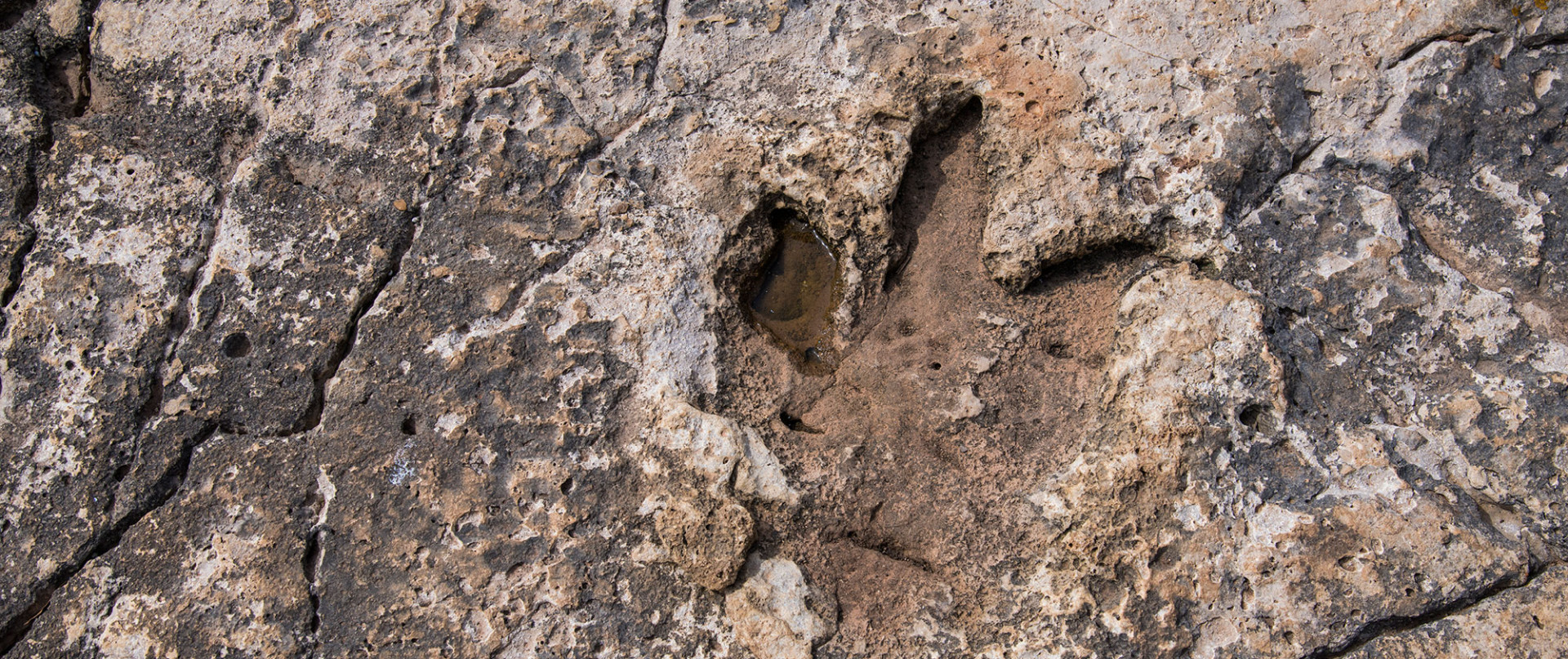
Dinosaur tracks from the Kamik/Plješivac site; top photo - track of a medium-sized ornithopod of the Iguanodon type; bottom photo: track of a small theropod dinosaur from the layer above.
Trstike cape
At Trstike / Debela Glava Cape on the southern side of Veliki Brijun Island, about thirty circular footprints of quadrupedal herbivorous sauropod dinosaurs have been found in Lower Cretaceous limestones dating to 105 million years ago. The tracks are chaotically distributed, making it very difficult to identify individual trackways. Forefoot impressions are also difficult to distinguish, as sauropod locomotion often causes overlap between fore- and hind-foot prints. This preservation pattern can also be observed at other Croatian sites.
The estimated length of the sauropods at this site is around 15 meters. In addition to Trstike, sauropod remains have also been found on Vanga Island within the Brijuni archipelago. Further detailed research is needed for more precise data. Interestingly, similar features to those described at Ploče as “turtle tracks” are also present here.
Circular sauropod footprints from the site on Cape Trstike, hammer length = 33 cm.
Vrsar Island
The richest dinosaur footprint site in the Brijuni National Park area is located on Vrsar Island, where around seventy three-toed theropod carnivorous dinosaur footprints have been discovered. There are also a few tracks that may indicate the presence of small ornithopod dinosaurs.
Of all Brijuni ichnofossil sites, Vrsar is the most affected by wave abrasion and seawater erosion, which significantly impacts the preservation of the tracks. The site is submerged for most of the year, and full study of the track-bearing layer is only possible during very low tides.
Tracks of small theropod dinosaurs on the island of Vrsar.
Discover the footprints of dinosaurs and briefly return to the ancient past, encountering these Mesozoic creatures (or at least their traces). We are waiting for you on Brijuni!
 Parks of Croatia
 EU projects
 English